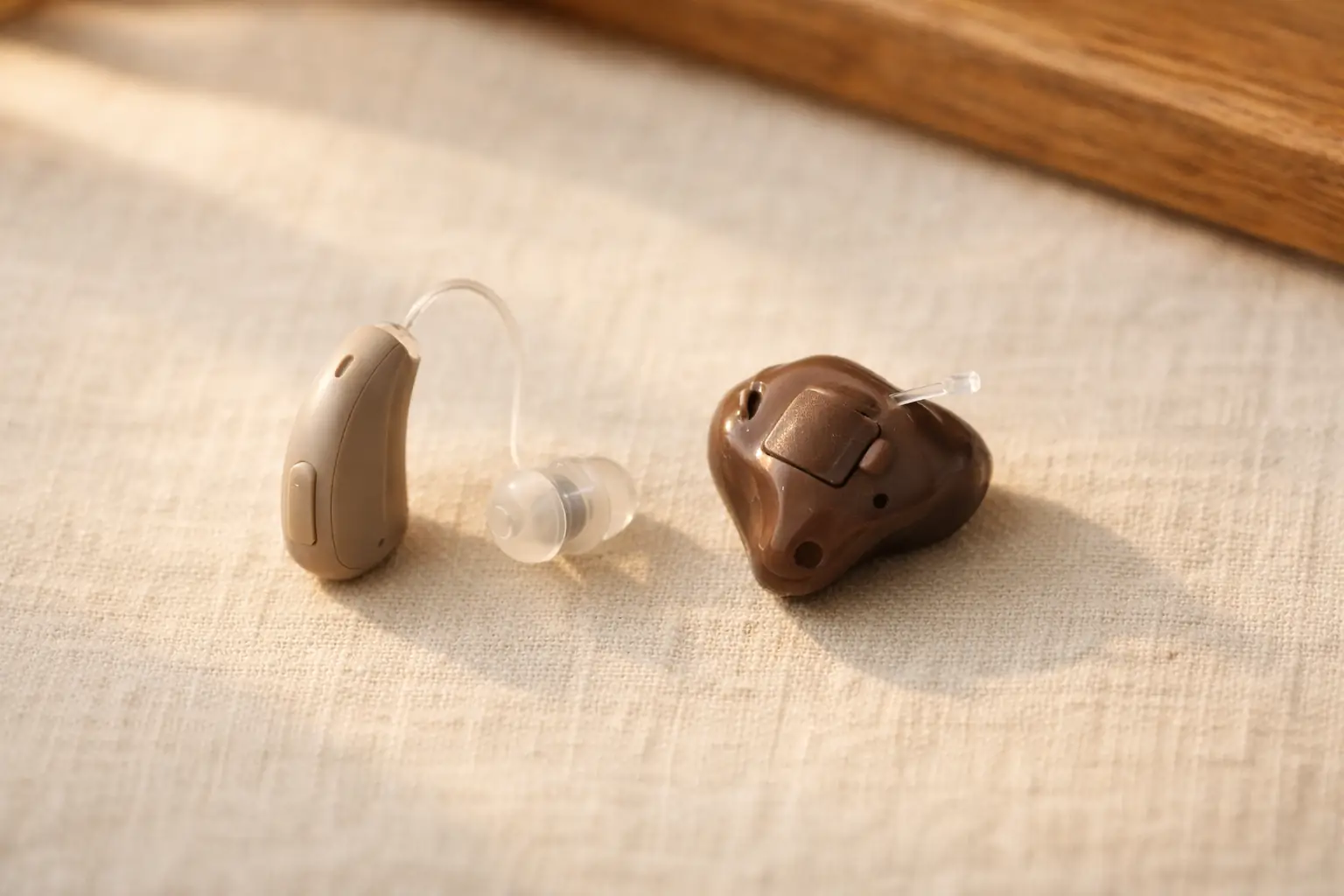
What the FDA's 2022 rule changed
In August 2022, the U.S. Food and Drug Administration (FDA) published a final rule creating a new category of over-the-counter (OTC) hearing aids. The rule took effect on October 17, 2022. Before then, buying a hearing aid in the United States generally meant going through a licensed professional.
Under the rule, OTC hearing aids:
- Are intended for people 18 and older with perceived mild to moderate hearing loss
- Can be sold in stores and online without a medical exam, prescription or fitting by an audiologist
- Must meet FDA requirements for safety and performance, including output limits
The FDA set a general maximum output of 111 decibels of sound pressure level (dB SPL), with up to 117 dB SPL allowed when input-controlled compression is active. Those limits are meant to protect users from sound that is loud enough to cause further damage.
Any hearing aid that is not an OTC hearing aid is a prescription hearing aid. Prescription hearing aids remain available only through a licensed hearing care professional.
What "perceived mild to moderate" means
The OTC category is based on what you notice yourself, not on a test. According to the FDA, signs that fit perceived mild to moderate hearing loss include:
- Speech sounding muffled
- Trouble following conversation in groups or noisy places
- Hearing better in one-on-one conversations than in groups
- Turning up the TV or radio louder than others like
- Asking people to repeat themselves
The difficulty is that people often underestimate or overestimate their own hearing loss. Our article on the signs you may need hearing aids covers the common patterns. A hearing test turns a guess into a measurement.
When OTC hearing aids may be a good fit
OTC devices can be a reasonable choice if:
- You are an adult with mild to moderate difficulty, mostly in noisy places
- Your hearing loss came on gradually and affects both ears similarly
- You are comfortable setting up a device with an app and troubleshooting on your own
- You do not have any of the red-flag symptoms listed below
Many OTC devices let you adjust volume and choose from preset programs. Some include a self-fitting app that plays tones and sets the device based on your responses.
When to see a professional first
The FDA lists warning signs that call for a medical evaluation before using any hearing aid. See a doctor, ideally an ear, nose and throat (ENT) physician, if you have:
- Fluid, pus or blood coming out of your ear in the past six months
- Pain or discomfort in your ear
- A history of excessive earwax, or suspicion that something is in your ear canal
- Vertigo or severe dizziness
- Sudden hearing loss, or quickly worsening hearing loss
- Hearing loss in only one ear, or much worse hearing in one ear
- Ringing or buzzing in only one ear
- An ear that looks deformed or has an obvious abnormality
Sudden hearing loss is an emergency. If you lose hearing suddenly, call a doctor right away. The National Institute on Deafness and Other Communication Disorders (NIDCD) notes that prompt treatment improves the chances of recovery.
People under 18 need prescription hearing aids. The FDA recommends that they see a doctor, preferably an ENT, because hearing loss in children needs specialized care. Clear Choice sees both adults and children, and Dr. Salim Bhaloo, DO, is a board-certified otolaryngologist.
How prescription hearing aids are different
Prescription hearing aids start with a full hearing evaluation. A professional then:
- Selects a style and technology level that suits your hearing and lifestyle
- Programs the hearing aids to your audiogram, frequency by frequency
- Checks how the hearing aids sound in your ears and fine-tunes them
- Follows up as your brain adapts, adjusting the settings over several visits
- Handles cleaning, repairs and warranty issues over the life of the device
Prescription hearing aids can be fitted for severe and profound hearing loss, which OTC devices are not designed for. They also come in custom-molded styles made from an impression of your ear.
At our Granbury office, our Doctor of Audiology fits ReSound, Oticon and Phonak hearing aids, among other manufacturers. Dr. Bhaloo also sees patients at our Weatherford office on Mondays.
Side-by-side comparison
Who can use them
OTC hearing aids are for adults 18 and older with perceived mild to moderate hearing loss. Prescription hearing aids are for any age and any degree of hearing loss.
How you get them
OTC devices are sold in stores and online. Prescription hearing aids come from a licensed hearing care professional after an evaluation.
Fitting
OTC devices are set up by you, using preset programs or an app. Prescription hearing aids are programmed by a professional to your measured hearing loss and adjusted at follow-up visits.
Support
OTC support usually comes from the manufacturer or retailer, by phone, chat or app. Prescription hearing aid support comes from your provider in person, often including cleanings and adjustments.
Cost
OTC hearing aids are generally the lower-cost option. Prescription hearing aids usually cost more because the price includes professional care. See how much hearing aids cost for what drives the difference.
Can you start with OTC and switch later?
Yes. Some people try OTC hearing aids first and then move to prescription devices if they still struggle, especially in noisy places, or if they want more help with fine-tuning. If you go the OTC route, it is still worth getting a hearing test. It can rule out problems that hearing aids will not fix, such as earwax blockage or a middle-ear problem, and it gives you a baseline to compare against later.
If earwax is the cause, removing it may be all you need. Read when to get earwax removed professionally.
A simple way to decide
- Check for the warning signs above. If any apply, see a professional first.
- Try our free online hearing check for a rough sense of how you hear soft sounds. It is a screening, not a diagnosis.
- Book a full hearing test to measure your hearing accurately.
- With your results, decide whether OTC or prescription hearing aids fit your hearing, your budget and how much support you want.
Frequently asked questions
Do I need a prescription to buy OTC hearing aids?
No. Adults 18 and older with perceived mild to moderate hearing loss can buy OTC hearing aids without a prescription, exam or fitting.
Are OTC hearing aids safe?
They must meet FDA requirements, including limits on maximum output. They are not intended for severe hearing loss or for anyone with the warning signs the FDA lists, such as ear pain, drainage or sudden hearing loss.
Can children use OTC hearing aids?
No. People under 18 need prescription hearing aids, and the FDA recommends seeing a doctor, preferably an ENT.
Will an audiologist adjust OTC hearing aids?
Some OTC devices can be adjusted by a professional and some cannot. Ask before you buy, and call us to check whether we can help with a specific device.
Do I need a hearing test before buying OTC hearing aids?
It is not required, but it is a good idea. A test can catch problems that hearing aids cannot fix and tells you whether your hearing loss is in the range OTC devices are designed for.
Sources
- U.S. Food and Drug Administration (FDA), "OTC Hearing Aids: What You Should Know"
- FDA final rule, "Medical Devices; Ear, Nose, and Throat Devices; Establishing Over-the-Counter Hearing Aids," Federal Register, August 17, 2022
- National Institute on Deafness and Other Communication Disorders (NIDCD), "Sudden Deafness"
- American Speech-Language-Hearing Association (ASHA), "Over-the-Counter Hearing Aids"
This article is general information, not a diagnosis. Talk with a provider about your own symptoms.